Small Business, Big Impact: Philanthropy’s Untapped Opportunity to Advance Health and Equity
nat rosasco • December 11, 2019

Introduction
Leaders in health philanthropy increasingly recognize the role of business in advancing their objectives. To date, the focus of most efforts to engage business has been primarily on large companies. By contrast, the role of small business in creating healthy, equitable communities has generally not been explored.
This is not entirely surprising for several reasons:
1)
large businesses present scale opportunities out of the gate. For example, a single corporate policy change at Walmart can affect more than two million employees;
2)
large corporations exert considerable influence on their peers and the public. When large companies act, their efforts tend to be newsworthy and cause ripple effects across their peers and society at large; and
3)
large, publicly-traded companies are relatively transparent and offer a source of considerable data that can be used to make the case for public health collaboration and measure progress toward a goal.
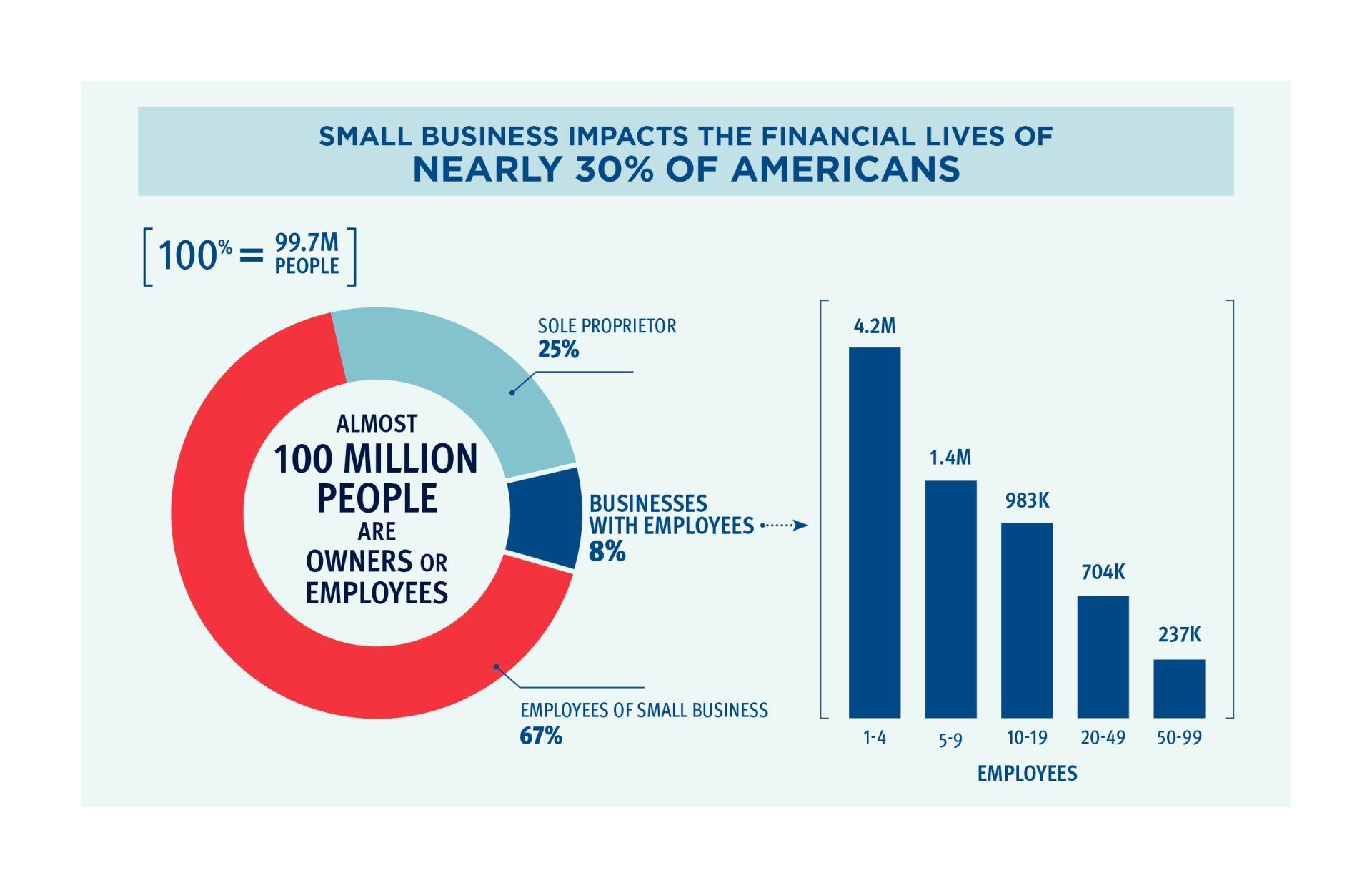
Yet small businesses are an untapped resource and could be a critical partner in creating opportunities for everyone to live a healthy life. Small business influences the financial lives of roughly 30% of the U.S. population: Nearly 100 million people
generate their livelihoods from small businesses as either owners or employees. These businesses are in every state in the country, representing more than 90% of all businesses in every state. Their voices are trusted at a time when confidence in government, media and other institutions is generally declining.
Small business leaders are largely untapped partners in advancing health for communities and their residents and in advancing health equity. Small business create jobs and build wealth—and especially in low-wealth communities—and the small business startup rate is highest in communities of color. Building wealth where opportunities have been historically limited is essential for advancing health equity. Moreover, as the second most trusted institution in the United States, a failure to engage small business leaders as partners and ambassadors in efforts to advance health and health equity is a missed opportunity.
Effectively channeling the potential of this critical segment of businesses will require effort and investment to address the unique characteristics that distinguish small business from large employers. For starters, the universe of small business is extremely fragmented, especially when compared to large corporations. In addition, unlike large businesses that can assign entire teams to special projects, small businesses are generally more strapped for time and resources. That said, it’s nearly impossible to address health equity and reach deep into communities without effectively engaging small business.
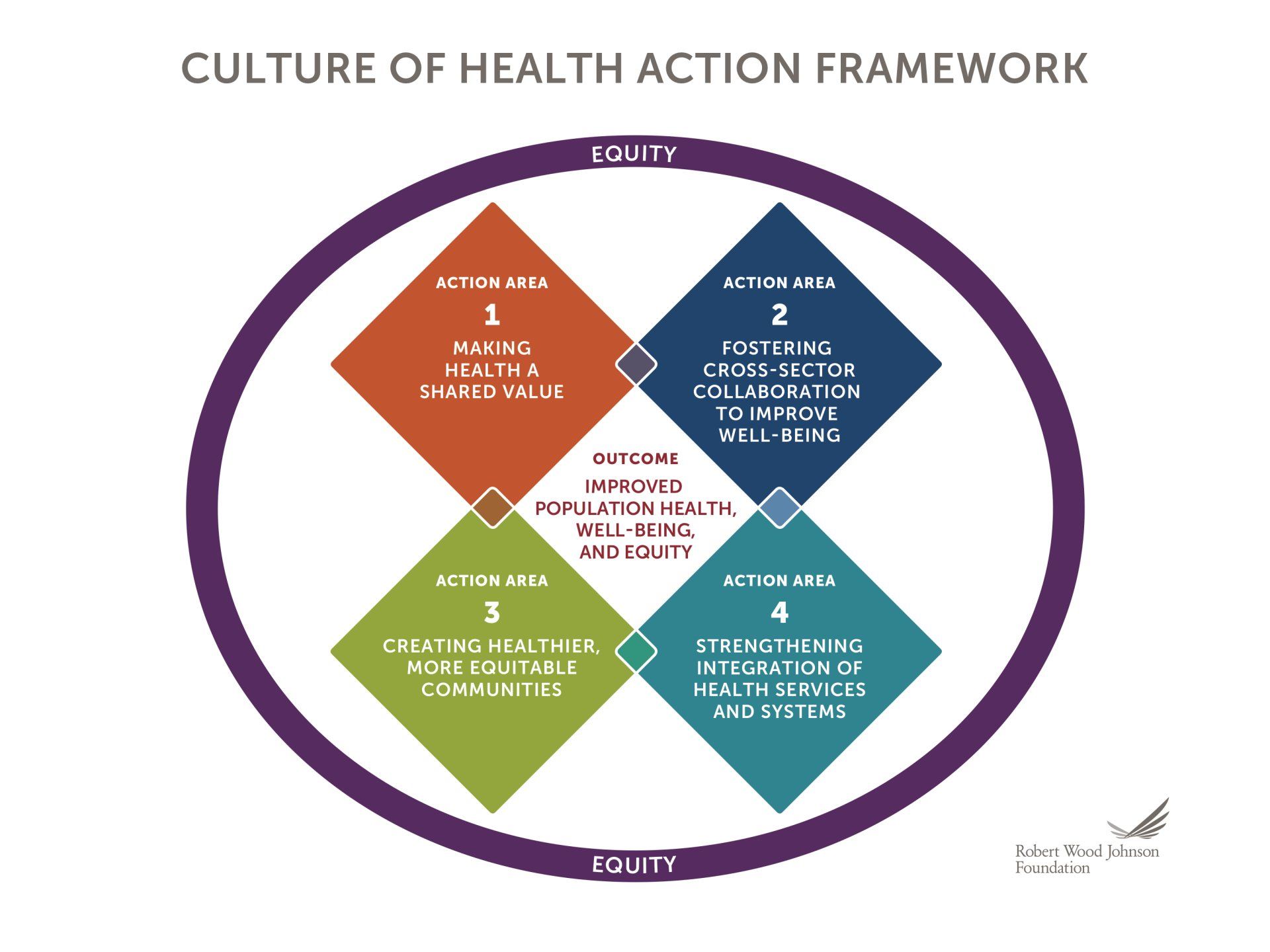
In this report, we start by making the case for engaging small business in advancing health equity, or what the Robert Wood Johnson Foundation (RWJF) has framed effectively as a “Culture of Health.” Then we share seven ways to engage small business in advancing healthy, equitable communities. Finally, we close with some recommendations to move forward including 1) the need for thoughtful investment in infrastructure to support engagement with small business; 2) opportunities for coordination among foundations that focus on a range of issue areas including health, community economic development, entrepreneurship, and racial equity; and 3) the potential for collaboration across sectors to ensure that public, private, and social sector actors with a vested interest in small business and healthy communities can contribute to advancing their critical shared objectives.
What is a “Culture of Health”
A “Culture of Health” represents the vision of The Robert Wood Johnson Foundation (RWJF) to make health a national priority, valued and advanced by collaborators from all sectors. For RWJF, building a Culture of Health means working together to develop scalable solutions and take targeted action in communities toward a shared goal of better health. To mobilize its vision, the Foundation created an Action Framework to drive measurable, sustainable progress and improve the health and well-being of all people.
The Case for Engaging Small Business
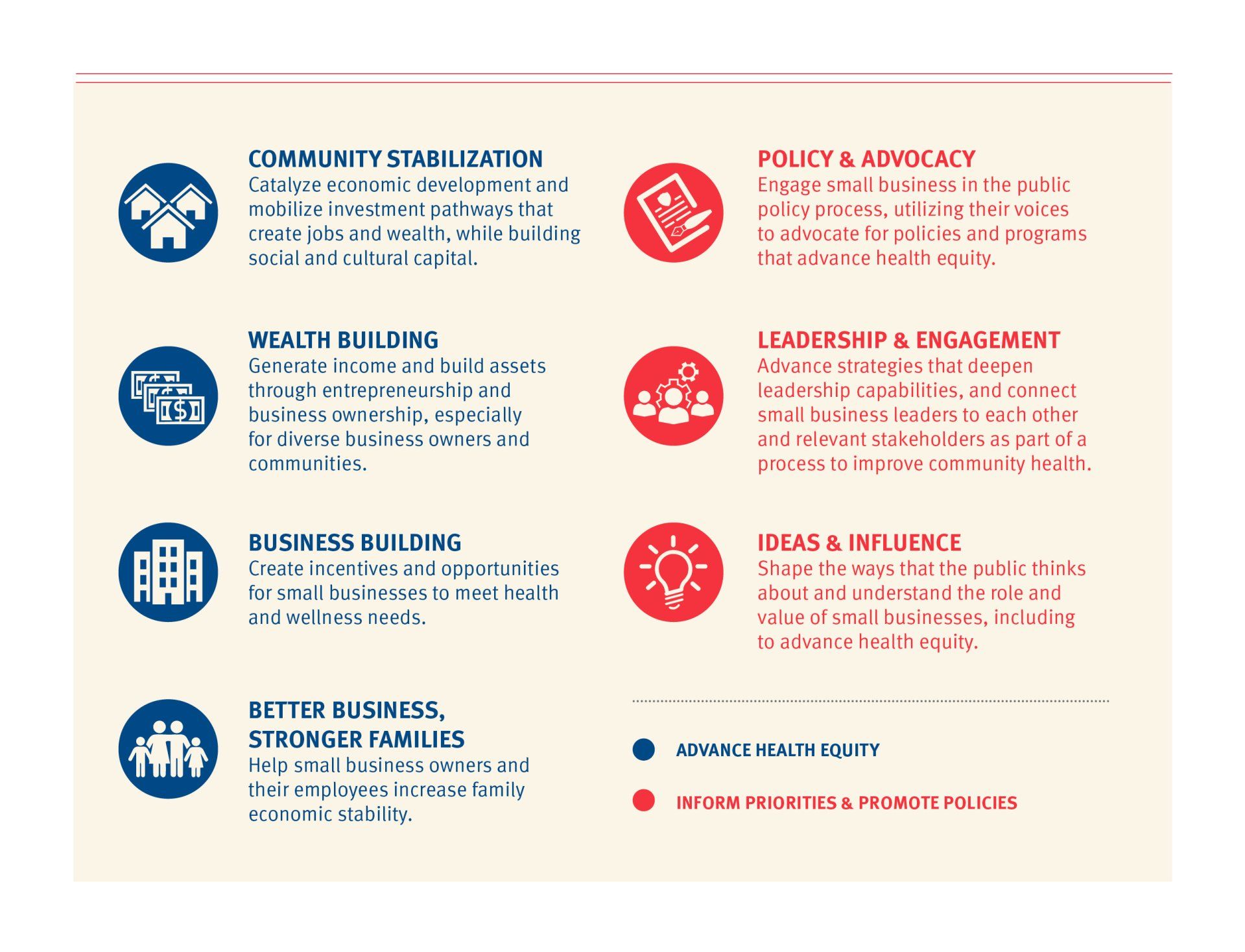
Small business owners generate wealth and create jobs in every community across the country, and are generally viewed as leaders in their communities. Engaging with small business allows you to 1) advance health equity and 2) inform priorities and promote policies.
Advance Health Equity
Building wealth and income is critical for improving health equity. Substantial evidence
shows that both wealth and income influence the health of individuals, and inequities in these areas have repeatedly been linked with poorer average health outcomes at the national level. Strategies to advance health equity should take into account the critical role of small business for both.
Somewhat surprisingly, 43% of small businesses
in the United States are located in low-wealth communities, which also suggests that these businesses are critical sources of jobs and income in these areas. Building wealth where opportunities have been historically limited is essential to advance health equity. Small businesses compete in virtually every industry sector, with the highest concentration in services, construction, and retail trade.
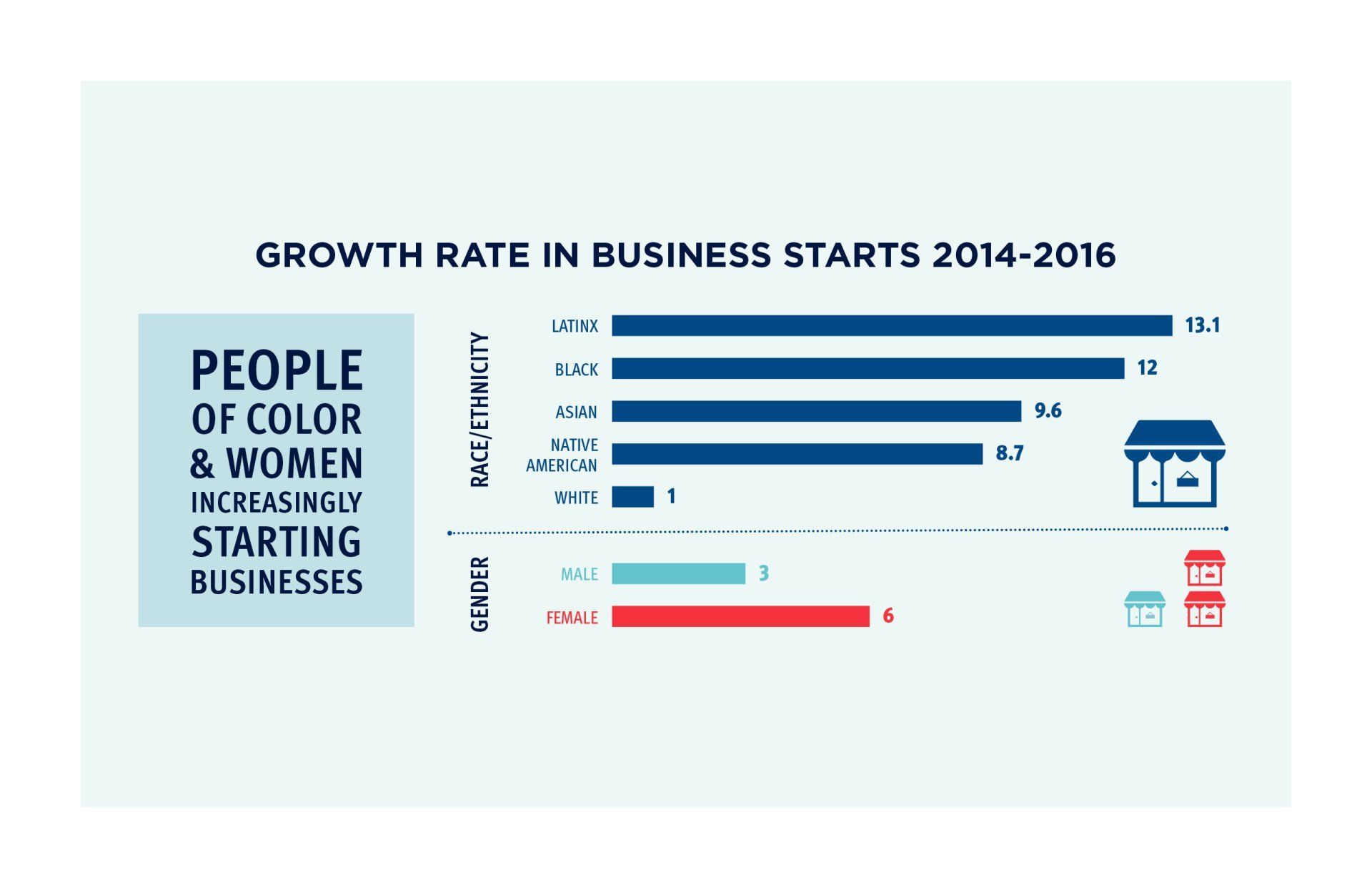
Business owners themselves represent a cross-section of the U.S. population. The majority of business owners today are white, but the growth rate
of business starts is highest among black Americans and Latino(a) business owners. More men own businesses than women, but about one-quarter
of businesses are women-owned and the share is growing rapidly, especially among black and Latina women. Boomers and millennials
also both represent sizable segments of small business owners, with a significant portion of young people considering starting a business.
Business ownership is also a driver of wealth creation. On average, business-owning households
hold more than twice the wealth of their wage-earning peers. The wealth-creation impact is more pronounced for business owners of color. Black business owners are, on average, more than seven times
wealthier than their wage-earning peers. Similarly, Latino(a) business owners hold roughly four times
as much wealth as non-business owners. Business ownership is also a proven path to addressing the racial wealth gap: while on average white adults hold 13 times
the net assets of their black peers, this racial wealth gap narrows by more than 75% to a three-fold differential when comparing business owners by race.
As these facts suggest, small business owners and employees represent a broad cross-section of American society who depend on and contribute directly and indirectly to health equity and healthy communities. The performance of small business contributes to healthy, equitable communities through the assets, income, and jobs they create. Small businesses can lead the way to advancing healthy communities when the practices they adopt shape the lives of their families and employees.
Inform Priorities & Promote Policies
Small business is the second most trusted
institution in the United States and is trusted far more than large business. This deep sense of trust creates an imperative both to understand authentic perspectives of small business owners and to harness that credibility to support policies that promote health equity.
Many of the stakeholders we interviewed, especially those who focus their work on advocacy, referred to the strong “moral authority” small business leaders convey on most issues. This was true for issues closely aligned with the direct interests of small business as well as broader issues of equity and inclusion, where the “voice of small business” contributed to policy momentum.
Knowing what is on the minds of small business owners can help identify priorities in a specific place or across the country. Additionally, support from small business can strengthen the case for policy proposals that advance healthy communities. Yet the sheer number of small businesses creates an imperative to capture enough inputs so that perspectives are representative and sample sizes are robust. However, reaching business owners directly can be challenging.
Small business owners are stretched thin and pressed for time. As one business owner shared, “You hustle and grind and sacrifice everything else in the name of success.” More than one owner we talked to relayed the quip that in a small business the CEO is the “Chief Everything Officer.” Business owners typically choose where and how to engage carefully, with an eye toward prioritizing activities that advance the business and address their pain points.
7 Ways to Engage Small Business for Health and Equity
Small businesses advance healthy communities and health equity by virtue of the contributions they make to the economic and social fabric of the places they serve. At the same time, this highly trusted segment of businesses can provide valuable insights into the needs and priorities of communities, and can serve as an important advocate for policy. In this section, we outline seven ways to engage small business. These themes are derived from the ways that small business contributes to healthy communities and insights from interviews with almost 100 practitioners and thought-leaders across the country.
Considerations Moving Forward
By virtue of their number, distribution, and trusted position, small businesses can lead the way to advancing healthy communities and health equity. However, absent purposeful action, the opportunity to harness their power will be missed. The seven themes outlined above present opportunities to rethink the current engagement model with “business” to include small business. At the same time, developing ideas within these themes presents the space to consider collaborations that move beyond the “usual suspects” to include some nontraditional partners. Our work has also highlighted the need for infrastructure investments to listen to and engage small business effectively and efficiently so that feedback loops are strengthened, data-driven insights are available, and the advocacy landscape is less purely partisan.
Finally, we see significant opportunities for “cross-sectoral” funding collaboratives to amplify impact of traditional community development. We observe many foundations engaged but from different vantage points. Getting to high-impact projects likely requires dialogue to “translate” language into common understanding, develop a shared frame, and identify shared priorities.
This report and the extensive research that informed it shows that small businesses are critical to creating healthy communities, but they continue to be an untapped resource. We hope this report helps lay the foundation for a better understanding about the leadership role that small business plays in our economy and society. This work should spark a dialogue among public health leaders (and others) to expand collaboration with “business” to include small business. The report frames themes and ideas that can strengthen meaningful engagement with small business—a vast and diverse constituency—and outlined opportunities for interested investors and funders who seek to advance health equity to include small business in their work.
Small business contributes to economic growth and plays a significant role in communities across the country, employing more than a quarter of the population, driving wealth creation in communities, and holding a spot as the second most trusted institution in the country. As such, small business can play a critical role in creating healthier and more equitable communities.

WANTING MORE NEWS? SIGNUP TODAY
Contact Us

WASHINGTON, D.C. – This month marks the anniversary of two pivotal pieces of legislation that are helping fuel a small business boom, the CHIPS & Science Act and the Inflation Reduction Act. Over the past four years, there has been a historic growth of American entrepreneurship across the country, with over 18 million new business applications filed, each one an act of hope and optimism in our economic future. This small business boom is fueled by investments like the Inflation Reduction Act and the CHIPS & Science Act. Rhett Buttle, Founder and CEO of Public Private Strategies, released the following statement: “As we mark the two-year anniversaries of the CHIPS & Science Act and the Inflation Reduction Act, the positive impact across the business landscape, and particularly for entrepreneurs, is unmistakable. The CHIPS & Science Act is fueling entrepreneurship opportunities by dedicating over $50 million to help develop new ideas and technologies to strengthen domestic semiconductor production and supply chain. “The Inflation Reduction Act has helped lower costs for workers and consumers, driving up demand for small businesses across the country. The healthcare provisions of the Inflation Reduction Act alone are saving millions Americans an average of $800 per year on health insurance premiums. These investments have helped fuel America’s small business boom, including a record 18 million new small business applications filed over the past four years. “We have more work to do to address the issues that business owners have consistently said are their top priorities, from lowering health care and prescription drug costs to expanding and streamlining contracting opportunities for small employers to strengthening and protecting American democracy . We remained committed to working with business leaders to address these challenges and ensure these investments are implemented effectively to grow economies and support communities all across the country.” ### About Rhett Buttle Founder & CEO, Public Private Strategies President, Public Private Strategies Institute Senior Fellow, The Aspen Institute Rhett Buttle is an entrepreneur, advocate, and one of the most trusted leaders at the intersection of business and policy in Washington, DC. He has worked for President Biden, Vice President Harris, President Barack Obama, Secretary of State Hillary Clinton, and Governor Arnold Schwarzenegger in government and campaign roles. Rhett is the founder of Public Private Strategies (PPS) and President of the Public Private Strategies Institute (PPSI), which works to bring together the public and private sectors to build coalitions, activate campaigns, and create strategic partnerships to drive policy and market outcomes. In these roles, he advises leading policy makers, foundations, nonprofits, and corporations. In addition to PPS and PPSI, he has helped found the Small Business Roundtable, Small Business for America’s Future, and the Next Gen Chamber of Commerce. He is also a Senior Fellow at the Aspen Institute and a regular contributor to Forbes, where he writes on the intersection of business, policy, and politics. Rhett has also been featured in The New York Times, CNN, The Wall Street Journal, and several other business publications. About Public Private Strategies Public Private Strategies (PPS) creates opportunities where the public and private sectors meet. We bring together diverse allies including foundations, associations, corporations, small businesses, and entrepreneurs to solve pressing societal challenges. By harnessing the power of the private sector, we build coalitions, activate campaigns, and create strategic partnerships to drive desired policy and market outcomes. Learn more at www.publicprivatestrategies.com .

WASHINGTON, D.C. – Today, the Bureau of Labor Statistics released its March jobs report, showing the US economy added 303,000 jobs in March while the unemployment rate fell to 3.8%. CNN characterized US job growth in March as “whopping,” with gains far outpacing economists' expectations. In response to the strong jobs report, Rhett Buttle, Founder of Public Private Strategies, released the following statement: “The labor market continues to exceed economists’ expectations, with over 300,000 jobs added in March – 50% more than economists anticipated. Bipartisan investments like the Bipartisan Infrastructure Law, CHIPS & Science Act, and Inflation Reduction Act are fueling broad-based economic growth that is strengthening the labor market, increasing consumer confidence , and leading to over 16 million new small business applications in the past three years – the most ever in that period and a reflection of deep optimism among American entrepreneurs about our economic future.” “Lawmakers must continue to double down on America’s economic momentum, and that starts with addressing the issues that business owners say are their top priorities, from lowering health care and prescription drug costs to strengthening and protecting American democracy .” ### About Rhett Buttle, Founder, Public Private Strategies and President, Public Private Strategies Institute Rhett Buttle is an entrepreneur, advocate, and one of the most trusted leaders at the intersection of business and policy in Washington, DC. Most recently, Rhett served as National Business Advisor to President Joe Biden’s 2020 campaign. He has worked for President Barack Obama, Secretary of State Hillary Clinton, and Governor Arnold Schwarzenegger. Rhett is the founder of Public Private Strategies (PPS) and President of the Public Private Strategies Institute (PPSI), which works to bring together the public and private sectors to build coalitions, activate campaigns, and create strategic partnerships to drive policy and market outcomes. In these roles, he advises leading policymakers, foundations, nonprofits, and corporations. About Public Private Strategies Public Private Strategies (PPS) creates opportunities where the public and private sectors meet. We bring together diverse allies including foundations, associations, corporations, small businesses, and entrepreneurs to solve pressing societal challenges. By harnessing the power of the private sector, we build coalitions, activate campaigns, and create strategic partnerships to drive desired policy and market outcomes. Learn more at www.publicprivatestrategies.com . As the United States marks the 14th anniversary of the AffordableCare Act (ACA), more Americans now have health care coverage than ever before. Since its enactment in 2010, the ACA has been a vital tool for Main Street, providing access to affordable healthcare options and fostering a healthier, more productive workforce.

WASHINGTON, D.C. – Today, the Bureau of Labor Statistics released its March jobs report, showing the US economy added 303,000 jobs in March while the unemployment rate fell to 3.8%. CNN characterized US job growth in March as “whopping,” with gains far outpacing economists' expectations. In response to the strong jobs report, Rhett Buttle, Founder of Public Private Strategies, released the following statement: “The labor market continues to exceed economists’ expectations, with over 300,000 jobs added in March – 50% more than economists anticipated. Bipartisan investments like the Bipartisan Infrastructure Law, CHIPS & Science Act, and Inflation Reduction Act are fueling broad-based economic growth that is strengthening the labor market, increasing consumer confidence , and leading to over 16 million new small business applications in the past three years – the most ever in that period and a reflection of deep optimism among American entrepreneurs about our economic future.” “Lawmakers must continue to double down on America’s economic momentum, and that starts with addressing the issues that business owners say are their top priorities, from lowering health care and prescription drug costs to strengthening and protecting American democracy .” ### About Rhett Buttle, Founder, Public Private Strategies and President, Public Private Strategies Institute Rhett Buttle is an entrepreneur, advocate, and one of the most trusted leaders at the intersection of business and policy in Washington, DC. Most recently, Rhett served as National Business Advisor to President Joe Biden’s 2020 campaign. He has worked for President Barack Obama, Secretary of State Hillary Clinton, and Governor Arnold Schwarzenegger. Rhett is the founder of Public Private Strategies (PPS) and President of the Public Private Strategies Institute (PPSI), which works to bring together the public and private sectors to build coalitions, activate campaigns, and create strategic partnerships to drive policy and market outcomes. In these roles, he advises leading policymakers, foundations, nonprofits, and corporations. About Public Private Strategies Public Private Strategies (PPS) creates opportunities where the public and private sectors meet. We bring together diverse allies including foundations, associations, corporations, small businesses, and entrepreneurs to solve pressing societal challenges. By harnessing the power of the private sector, we build coalitions, activate campaigns, and create strategic partnerships to drive desired policy and market outcomes. Learn more at www.publicprivatestrategies.com . As the United States marks the 14th anniversary of the AffordableCare Act (ACA), more Americans now have health care coverage than ever before. Since its enactment in 2010, the ACA has been a vital tool for Main Street, providing access to affordable healthcare options and fostering a healthier, more productive workforce.

WASHINGTON, D.C. – This week, the U.S. Small Business Administration (SBA) announced the agency's first-ever voter registration agreement with the Michigan Department of State (MDOS). This landmark memorandum of understanding (MOU), signed to bolster civic engagement and voter registration efforts in Michigan, marks a significant milestone in empowering small business owners. Under the MOU, MDOS will create a dedicated URL for the SBA, enabling online visitors to easily register to vote. Additionally, MDOS officials will have the opportunity to conduct in-person voter registration at SBA's small business outreach events, providing direct support to entrepreneurs. Michigan, with its thriving small business sector of over 900,000 enterprises employing 1.9 million individuals, stands to benefit significantly from this initiative. The SBA, in an effort to bolster its mission of ensuring small businesses thrive, will also promote voter registration nationwide by integrating information from Vote.gov into its marketing materials, website, and social media channels, and through signage at SBA offices and events throughout the country. Following the announcement, Rhett Buttle, Founder of Public Private Strategies & President of the Public Private Strategies Institute, released the following statement: "Small business owners have the power to drive positive change. This historic collaboration between the SBA and MDOS underscores the shared commitment to amplifying the voices of small business owners in Michigan and across the nation. By providing access to voter registration information, businesses are supported, and our democracy is strengthened, which is crucial for our economic prosperity. This agreement fosters a culture of civic engagement that benefits us all." Small business owners interested in registering to vote in Michigan can visit the Michigan Department of State's Voter Information Center at mvic.sos.state.mi.us . For more information about the SBA's programs, financial assistance, and services supporting small businesses, visit www.sba.gov . ### About Rhett Buttle, Founder, Public Private Strategies and President, Public Private Strategies Institute Rhett Buttle is an entrepreneur, advocate, and one of the most trusted leaders at the intersection of business and policy in Washington, DC. Most recently, Rhett served as National Business Advisor to President Joe Biden’s 2020 campaign. He has worked for President Barack Obama, Secretary of State Hillary Clinton, and Governor Arnold Schwarzenegger. Rhett is the founder of Public Private Strategies (PPS) and President of the Public Private Strategies Institute (PPSI), which works to bring together the public and private sectors to build coalitions, activate campaigns, and create strategic partnerships to drive policy and market outcomes. In these roles, he advises leading policymakers, foundations, nonprofits, and corporations. About Public Private Strategies Public Private Strategies (PPS) creates opportunities where the public and private sectors meet. We bring together diverse allies including foundations, associations, corporations, small businesses, and entrepreneurs to solve pressing societal challenges. By harnessing the power of the private sector, we build coalitions, activate campaigns, and create strategic partnerships to drive desired policy and market outcomes. Learn more at www.publicprivatestrategies.com . As the United States marks the 14th anniversary of the AffordableCare Act (ACA), more Americans now have health care coverage than ever before. Since its enactment in 2010, the ACA has been a vital tool for Main Street, providing access to affordable healthcare options and fostering a healthier, more productive workforce.

WASHINGTON, D.C. – As the United States marks the 14th anniversary of the AffordableCare Act (ACA), more Americans now have health care coverage than ever before. Since its enactment in 2010, the ACA has been a vital tool for Main Street, providing access to affordable healthcare options and fostering a healthier, more productive workforce. Over the past decade, the ACA has significantly benefited entrepreneurs and workers by offering affordable coverage options through Health Insurance Marketplaces, providing tax credits to ease the cost of providing healthcare, and eliminating pre-existing condition exclusions. These provisions have brought stability and predictability to healthcare costs, allowing businesses to plan for the future with confidence. To mark the 14-year anniversary of the ACA, Rhett Buttle, Founder of Public Private Strategies and appointee at the Department of Health and Human Services under President Obama, released the following statement: "The Affordable Care Act has been an important milestone for businesses, entrepreneurs and workers across America. Today, more Americans have health insurance than ever before in our history. By offering affordable healthcare options and removing barriers, the ACA has allowed entrepreneurs to focus on what they do best – innovate, grow, and create jobs. “The ACA has set a strong foundation for access to high-quality and affordable care, but there’s so much more we need to do to help our job creators thrive. Building off the ACA, the Inflation Reduction Act takes important steps to tackle healthcare costs in our country. We must continue this progress and tackle these important issues. In survey after survey , small business owners have identified the cost of healthcare and prescription drug prices as their top concern. We should strengthen recent action to lower the cost of prescription drugs and continue to provide strong subsidies to make the plans offered under the ACA affordable to more Americans.” ### About Rhett Buttle, Founder, Public Private Strategies and President, Public Private Strategies Institute Rhett Buttle is an entrepreneur, advocate, and one of the most trusted leaders at the intersection of business and policy in Washington, DC. Most recently, Rhett served as National Business Advisor to President Joe Biden’s 2020 campaign. He has worked for President Barack Obama, Secretary of State Hillary Clinton, and Governor Arnold Schwarzenegger. Rhett is the founder of Public Private Strategies (PPS) and President of the Public Private Strategies Institute (PPSI), which works to bring together the public and private sectors to build coalitions, activate campaigns, and create strategic partnerships to drive policy and market outcomes. In these roles, he advises leading policymakers, foundations, nonprofits, and corporations. About Public Private Strategies Public Private Strategies (PPS) creates opportunities where the public and private sectors meet. We bring together diverse allies including foundations, associations, corporations, small businesses, and entrepreneurs to solve pressing societal challenges. By harnessing the power of the private sector, we build coalitions, activate campaigns, and create strategic partnerships to drive desired policy and market outcomes. Learn more at www.publicprivatestrategies.com . As the United States marks the 14th anniversary of the AffordableCare Act (ACA), more Americans now have health care coverage than ever before. Since its enactment in 2010, the ACA has been a vital tool for Main Street, providing access to affordable healthcare options and fostering a healthier, more productive workforce.

WASHINGTON, D.C. – Today, the Biden-Harris Administration announced a record 16 million new small business applications in the last three years. The numbers also highlighted that diverse-owned businesses are on the rise. These statistics are a testament to the significant impact that the Investing in America agenda has had for businesses owners, diverse businesses, and their communities. The record number of new business applications is also a sign that small businesses and entrepreneurs are confident and optimistic about the economy, generating resilient and competitive markets, and growing opportunities for Americans. Following the announcement, Rhett Buttle, Founder of Public Private Strategies, released the following statement: “This historic number of new business applications is an exciting sign of the economic resilience of American entrepreneurial spirit. As a result of the investment through the Investing America agenda, led by the Biden-Harris Administration and Congress, small business owners and entrepreneurs are newly equipped with the tools necessary to succeed and excel. These investments, the majority of them the result of bipartisan cooperation, from the Bipartisan Infrastructure Law, Inflation Reduction Act, and Chips and Science Act, are delivering for communities across the country and creating an economy where businesses small and large can thrive. Coming out of the global pandemic the United States has seen unprecedented growth with major new federal investments providing small business owners and entrepreneurs with the tools and resources to generate new businesses, jobs, and a strong economic future.” ###

WASHINGTON, D.C. – Last week, a bipartisan group of members from both the Senate and the House of Representatives announced an effort to advance paid leave legislation. The new, bicameral efforts will explore solutions to paid parental, caregiving, and personal medical leave for all Americans. The bipartisan group is seeking input from advocacy, business, and other stakeholder organizations to ensure the policies put forth by the group are effective and meaningful for employers and employees. The Request for Information creates a framework for stakeholder input and ensures that small and large business voices are heard throughout the process. In May, Public Private Strategies facilitated a roundtable with the House Paid Leave Working Group and small business leaders and owners from 11 organizations to discuss the opportunities and challenges to offering paid family and medical leave benefits for employees. The roundtable explored potential pathways forward for both small business owners and the self employed. In a report published by the House Paid Leave Working Group, key findings from the roundtable included: Small business owners want to provide paid leave to their workers. Small businesses recognize that paid family leave would level the playing field with large employers, helping them compete with larger employers to attract and retain workers. Highlighting how government supported solutions to expand access to paid leave can incentivize entrepreneurship by giving entrepreneurs themselves access to the benefit. Small business owners want to provide the benefit, they grapple with two primary challenges in doing so: cost and staffing. Following the announcement, Katie Vlietstra Wonneberg, Principal of Public Private Strategies, released the following statement: “The announcement last week of the Senate Bipartisan Working Group and the Bicameral Bipartisan RFI to explore solutions around paid leave is an exciting new step in the right direction to creating a paid leave policy. In the 30 years since the creation of FMLA, we have yet to advance paid leave that is inclusive of all size businesses. “The business community has been active in the conversations over the past year in coordination with the House Bipartisan Work Group. With the next iteration of these conversations being convened in the Senate, there is a great opportunity to continue to engage with the business community, who see paid leave as a way to ensure small businesses can compete for talent, provide a valued benefit to employees, and ensure continuity in their workforce. Public Private Strategies applauds the bicameral, bipartisan efforts to ensure that all stakeholders are invited to participate and explore innovative pathways forward on paid leave. We welcome the opportunity to work closely with each office to provide insights and expertise on a framework that works for all businesses including the self employed.” ###

WASHINGTON, D.C. – Since 2010, Small Business Saturday has recognized and celebrated the contributions of small, independent businesses, which are the foundation of the U.S. economy and the lifeblood of local communities. November and December account for almost 20% of small businesses total retail sales each year, making the holiday season a critical time for local entrepreneurs, Main Streets across the country, and economic growth overall. Due to the economic investments made by the Biden-Harris Administration including the Bipartisan Infrastructure Law, Inflation Reduction Act, and CHIPS and Science Act, we have seen historic investments in small businesses. A recently released fact sheet by the White House shows the impact of these investments in communities, including a record 14.6 million applications to start businesses. Ahead of this year’s Small Business Saturday, Rhett Buttle, Founder of Public Private Strategies, released the following statement: “The holiday season is one of the most vital times of the year for small businesses, bringing workers, consumers, communities, and the economy together and generating innovation and prosperity,” said Rhett Buttle. “Small businesses employ over 61 million Americans, about half of private sector employees, and are the backbone of our communities and economy. Data from the U.S. Census Bureau on new small business applications shows that the past two years have been the strongest two years on record for new small business applications – as a result of the Investing in America agenda. As entrepreneurs continue to build small businesses, economic growth flows into communities across the country, encouraging investments and fostering a stronger economy and democracy.” Here are Some of the Public Private Strategies Team’s Favorite Small Businesses: Beuch e rt’s Saloon - District of Columbia Hill’s Kitchen - District of Columbia Salt & Sundry - District of Columbia Brave + Kind Bookshop - Georgia Revelry Brewing - Maryland Snug Books - Maryland Pamela Salisbury - New York Sphere + Sundry - Online Brut Champagne and Wine Bar - Virginia Grooming Store - Virginia Reedville Coffee House - Virginia Independent K9 - West Virginia ###

WASHINGTON, D.C. – Two years ago, President Biden signed the Bipartisan Infrastructure Law, a historic investment in America’s infrastructure and clean energy economy. The law marks the most significant piece of infrastructure legislation in decades, designating funding for roads, bridges, broadband, energy, transportation, and much more. Since its passage, the United States has seen remarkable progress and economic growth, putting American businesses at the forefront of global competition. Public Private Strategies Institute (PPSI) has partnered with the U.S. Small Business Administration & the U.S. Department of Commerce to launch a webinar series focused on expanding public awareness of opportunities stemming from the Bipartisan Infrastructure law and other economic investments in the Investing in America agenda. Specifically, the initiative will educate business leaders about how investments in infrastructure, clean energy, manufacturing and more can create opportunities for them, their communities, and the economy overall. In addition, last year, PPSI launched Build Up Local , an initiative in partnership with the National Urban League (NUL) and National Minority Supplier Development Council (NMSDC) . Build Up Local provides business owners with resources and programs made available through the Bipartisan Infrastructure Law, equipping small businesses with information on infrastructure contracting opportunities and more. Ahead of the two-year anniversary of the Bipartisan Infrastructure Law, Rhett Buttle, Founder of Public Private Strategies & President of the Public Private Strategies Institute, released the following statement: "The Bipartisan Infrastructure Law has had an enormous impact on American businesses and the economy at large. By investing in our nation’s aging infrastructure, the Biden-Harris Administration has taken monumental steps to once again put the United States in a competitive position on the global stage. As we come up on two years of this historic achievement, we continue to see the benefits that businesses are reaping. Initiatives like Build Up Local, are crucial to ensuring small businesses and entrepreneurs from all backgrounds access contracting opportunities made available under the legislation and have the resources they need to succeed in our growing economy.” ###


